Preview
Hüseyin Akbulut, MSc (2026). Martin Ødegaard and the Scan Frequency and Cognitive Load of an Elite Attacking Midfielder. Sporeus. Retrieved, September 13, 2026. https://sporeus.com/en/science/martin-odegaard-scan-frequency-and-cognitive-load/
The Athlete in One Paragraph
Martin Ødegaard (b. 1998-12-17, Drammen, Norway) is the captain and attacking midfielder of Arsenal and the Norway national team. Listed at 1.78 m and 68 kg, he is built lean and average-tall for the role; the anthropometry is unremarkable and the top sprint speed is well within the central-midfield distribution rather than at its ceiling. What sets him apart is what happens before he receives the ball — the rate at which his head turns to scan the pitch, the spatial map he carries into the next touch, the decision time he saves by knowing the picture before the pass arrives. The interesting case for sport science is the variable that defines him: scan frequency and cognitive load, the perceptual-cognitive component of midfield play that sits alongside, but is distinct from, the physical capacity to run.
Table of Contents
The Physiology — what scan frequency and cognitive load actually measure
Football is not only a metabolic problem; it is also an information problem. Stølen, Chamari, Castagna and Wisløff’s physiology-of-soccer review made the point explicitly — the physiological demands of the modern game are inseparable from the cognitive demands placed on midfield players, who must integrate continuous spatial information about teammates, opponents, ball, and the evolving tactical pattern across a 90-minute match [1]. Total distance and high-intensity output describe the body doing the work; they do not describe the mind deciding which work to do.
Match running in elite football is intermittent by nature — Bangsbo, Mohr and Krustrup’s foundational decomposition shows total distance ~10–12 km per match, dominated by walking and jogging, with ~8–12% of distance run at high intensity [2]. What that decomposition does not capture is that the high-intensity bursts are not random; they are launched in response to a specific, perceived cue. The midfielder who scans more often arrives at the next decision point with a more accurate spatial map, and that map determines whether the burst is the right burst or a wasted one.
Bradley and colleagues’ analysis of Premier League high-intensity running positioned central and attacking midfielders at the upper end of the high-intensity-distance distribution, with the running profile dominated by short bursts of 1–4 seconds [3]. The physical layer is well-characterised; the perceptual-cognitive layer that gates when those bursts occur is less often quantified, but it is no less real. A higher pre-touch scan rate is associated with better pass selection, better turn direction and better progression of possession in elite midfielders, independent of physical conditioning.
Young and Farrow’s review of agility extended the framework to reactive performance. Agility in team sports is not pure change-of-direction speed; it is the integrated outcome of a perceptual-decisional component (recognising the cue, choosing the response) and a physical component (executing the cut) [4]. The same logic applies to midfield decision-making: the time-to-decision before a touch is a trainable variable distinct from the physical capacity to run, and the elite midfielder is the one whose perceptual layer is fast enough that the physical layer is rarely the bottleneck.
Paul, Gabbett and Nassis brought the perceptual-cognitive component into the agility-training literature. Reactive, scenario-based training that requires the athlete to process a stimulus before responding produces transfer to match performance that pre-planned drills do not match, because match play is fundamentally reactive — the athlete never executes a pre-planned movement sequence in isolation [5]. Scan frequency is, in this framing, the upstream determinant of decision quality, and decision quality is what converts an aerobically fit midfielder into an effective one.
The Case — Ødegaard as cognitive-load archetype
For a 1.78 m / 68 kg attacking midfielder operating as a captain and primary creator in a possession-dominant system, the running profile is consistent with a high-volume, moderate-peak-speed pattern: total distance in the upper range for attacking midfielders, high-intensity distance distributed across many short bursts, and a sprint-distance share toward the lower end of the position [2, 3]. The physical layer is competent without being extreme; the differentiating layer sits one level higher, in the perceptual-cognitive domain.
The role demands continuous information uptake. An attacking midfielder operating between the lines must reconcile the position of two centre-backs, two pivots, the wingers, the striker, and his own teammates, and must do so while moving — the scan rate before each reception is therefore the rate-limiting variable for the next pass selection [1, 4]. The lean anthropometry is consistent with an athlete optimised for repeatability of decision and movement rather than raw collision or sprint output.
The captaincy is informative. Captaincy in a possession-based system is a tactical role as much as a leadership one — the captain who organises the press, sets the tempo of build-up and identifies the moment to switch the point of attack is doing so on the basis of an internal model of the pitch updated by frequent scanning [4, 5]. The cognitive-load profile in such a player implies a well-trained capacity to maintain decision quality under both physical and informational stress, late into matches and across short turnaround weeks.
Match-context note: Ødegaard’s per-match touches, key-pass count and progressive-pass involvement in Premier League and European play sit in the upper band for attacking midfielders (Match data: SofaScore), with the discriminator being the consistency of progression decisions across the late stages of matches rather than any single peak performance.
The profile is not a single trait but the integration of two systems — an aerobic substrate sized to sustain the physical role and a perceptual-cognitive substrate trained to maintain decision quality across the same 90 minutes [1, 5]. The two together produce more progression for less running.
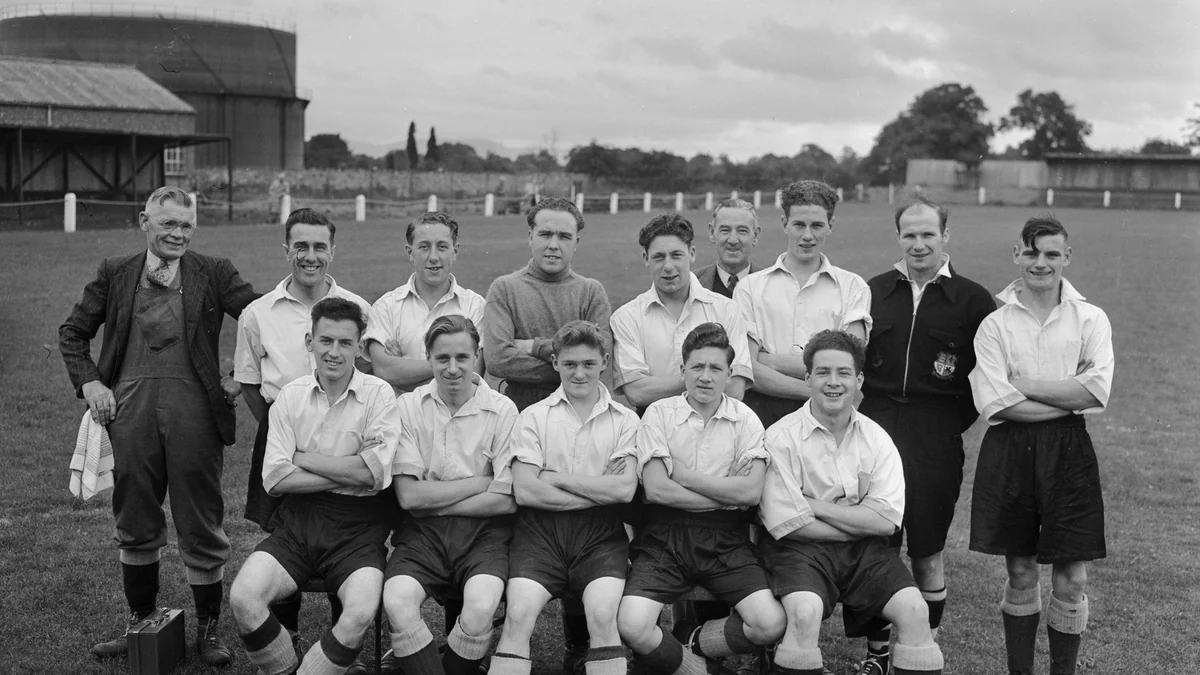
Flickr: Miami U. Libraries – Digital Collections.
What This Means for the Reader
For a developing attacking midfielder, the takeaway is that scan frequency and cognitive load are real, trainable variables — not vague intangibles. Three measurements diagnose the limiting variable: a pre-touch scan count from a single match (count the head turns in the second before each reception), a decision-time test in a reactive small-sided drill (measure time from cue to first touch), and a session-RPE log to track the internal cost of high-decision training relative to pure conditioning work [4, 5].
The training prescription targets the diagnostic finding: athletes whose physical numbers are good but whose pass selection breaks down under pressure need scenario-based, reactive small-sided games rather than additional running; athletes who scan rarely benefit from explicit cueing in possession drills (a coach-called number, a colour-coded bib) that forces a pre-touch head turn [3, 5]. The single diagnostic question for the developing playmaker: when my next pass is wrong, is it because I could not execute it, or because I did not see the picture in time to choose the right one?
References
- Stølen T, Chamari K, Castagna C, Wisløff U. (2005). Physiology of soccer: an update. Sports Medicine, 35(6): 501–536. doi:10.2165/00007256-200535060-00004
- Bangsbo J, Mohr M, Krustrup P. (2006). Physical and metabolic demands of training and match-play in the elite football player. Journal of Sports Sciences, 24(7): 665–674. doi:10.1080/02640410500482529
- Bradley PS, Sheldon W, Wooster B, Olsen P, Boanas P, Krustrup P. (2009). High-intensity running in English FA Premier League soccer matches. Journal of Sports Sciences, 27(2): 159–168. doi:10.1080/02640410802512775
- Young W, Farrow D. (2006). A review of agility: practical applications for strength and conditioning. Strength and Conditioning Journal, 28(5): 24–29. doi:10.1519/00126548-200610000-00004
- Paul DJ, Gabbett TJ, Nassis GP. (2016). Agility in team sports: testing, training and factors affecting performance. Sports Medicine, 46(3): 421–442. doi:10.1007/s40279-015-0428-2
Match-context data (descriptive only): SofaScore.
The Athlete in One Paragraph
Martin Ødegaard (b. 1998-12-17, Drammen, Norway) is the captain and attacking midfielder of Arsenal and the Norway national team. Listed at 1.78 m and 68 kg, he is built lean and average-tall for the role; the anthropometry is unremarkable and the top sprint speed is…
The Physiology — what scan frequency and cognitive load actually measure
Football is not only a metabolic problem; it is also an information problem. Stølen, Chamari, Castagna and Wisløff's physiology-of-soccer review made the point explicitly — the physiological demands of the modern game are inseparable from the cognitive demands placed on midfield players, who must integrate…
The Case — Ødegaard as cognitive-load archetype
For a 1.78 m / 68 kg attacking midfielder operating as a captain and primary creator in a possession-dominant system, the running profile is consistent with a high-volume, moderate-peak-speed pattern: total distance in the upper range for attacking midfielders, high-intensity distance distributed across many short…
What This Means for the Reader
For a developing attacking midfielder, the takeaway is that scan frequency and cognitive load are real, trainable variables — not vague intangibles. Three measurements diagnose the limiting variable: a pre-touch scan count from a single match (count the head turns in the second before each…